
READY TO GO ELECTRIC?

Electric vehicles are becoming more accessible, practical and affordable to run.
Thinking about your next vehicle? An electric vehicle (EV) could cost less to run than you think.
From charging at home overnight to spending less on energy and routine servicing, EV ownership can look very different from what you might expect.
The question isn't only: “How much does an EV cost?”
It's: “How much will it cost me to own and run?”
EVs aren't just for luxury buyers
For many years, electric vehicles were associated with expensive, premium cars.
That's changing.
There are now several EV models available in the Western Cape for less than R600 000, including models priced below R400 000.
Electric vehicles less than R600 000
| Make | Model | Price | Battery capacity | Claimed Range | Est real-world range | Boot capacity |
| Geely | E2 | R339 900 – R389 900 | 39.4 kWh | 325 km | 285 km | 375 litres |
| BYD | Dolphin Surf | R341 900 – R395 900 | 30.1 – 38.9 kWh | 220 – 300km | 200 – 280 km | 230 litres |
| Dongfeng | Box | R349 000 – R389 900 | 43.9 kWh | 430 km | 300 km | 326 litres |
| Chery | Q | R349 900 – R389 900 | 42.7 kWh | 400 km | 300 km | 375 litres |
| Dongfeng | 06 | R499 000 – R579 900 | 44.9 – 51.9 kWh | 401 km | 300 km | 500 litres |
| iCaur | V23 | R519 900 | 59.9 kWh | 360 km | 300 km | |
| BYD | Atto 2 | R529 900 | 51.1 kWh | 345 km | 300 km | 400 litres |
| Jaecoo | J5 EV | R549 900 | 58.9 kWh | 402 km | 340 km | 480 litres |
| GWM | Ora 5 | R549 900 – R599 900 | 58.3 kWh | 500 km | 340 km | 362 litres |
Prices and vehicle specifications are subject to change. Check with the manufacturer or dealer for current pricing.
So, what does it actually cost to run one? That's where things get interesting.
The cost of running your car
Don't just look at the price on the showroom floor.
When you buy a car, the purchase price is only the beginning. Every month, you also pay to keep it moving, through fuel or electricity, servicing and other running costs.
For EVs, the cost of the energy used to drive can be significantly lower than the cost of petrol.
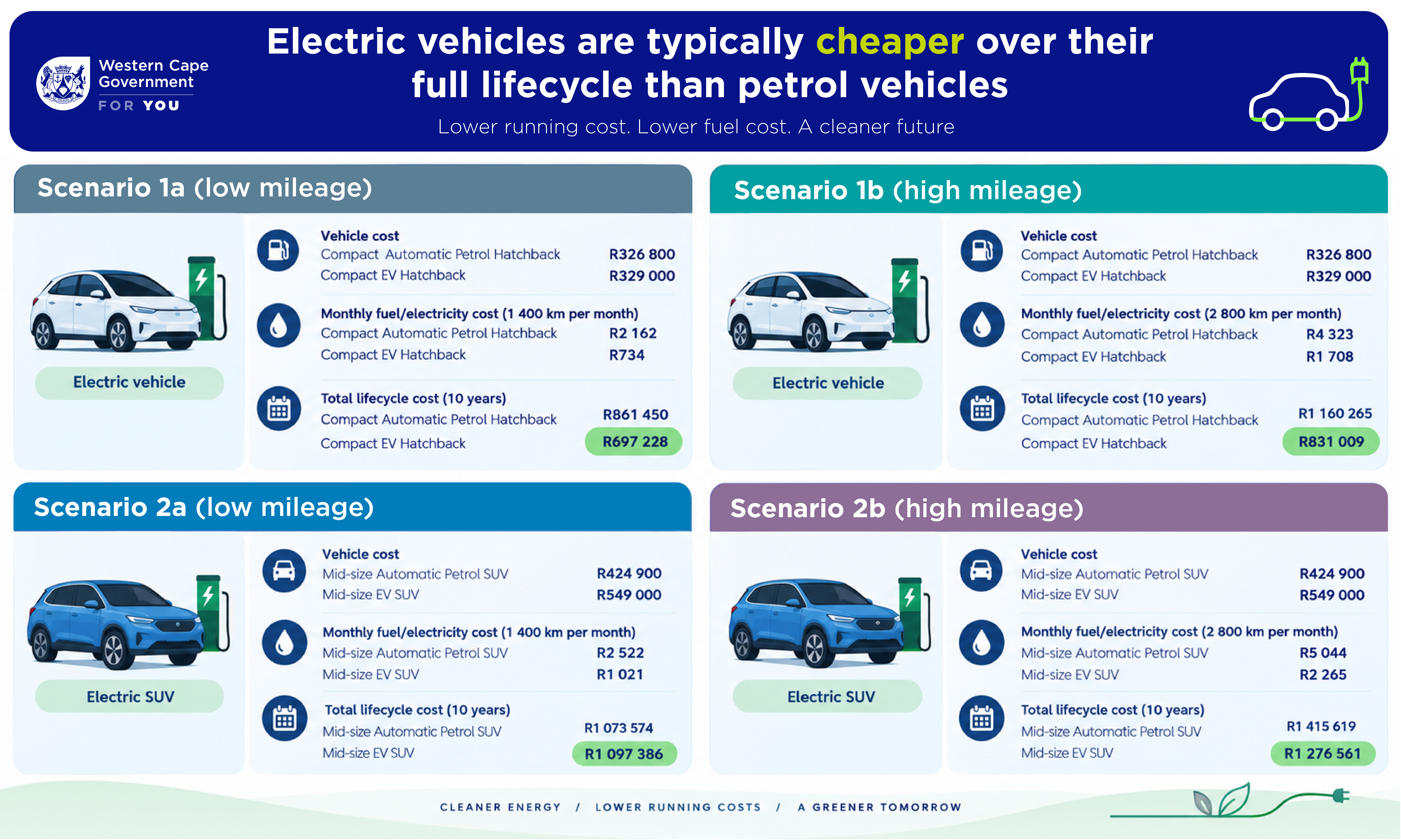
These are average figures. Actual costs will vary depending on the vehicle, electricity tariff, fuel price, driving conditions and charging method.
But what about charging?
Charging an EV can become part of your everyday routine.
One of the biggest differences between an EV and a petrol vehicle is where and when you refuel. With a petrol car, you usually need to make a trip to the filling station. With an EV, you can often charge while you're already at home, at work, shopping or going about your day.
At home
Plug in when you get home. Go to sleep. Wake up ready to go.
On the road
Stop at a public charger. Take a break. Continue your journey.
It's a different way of thinking about "filling up".
How long does it take to charge?
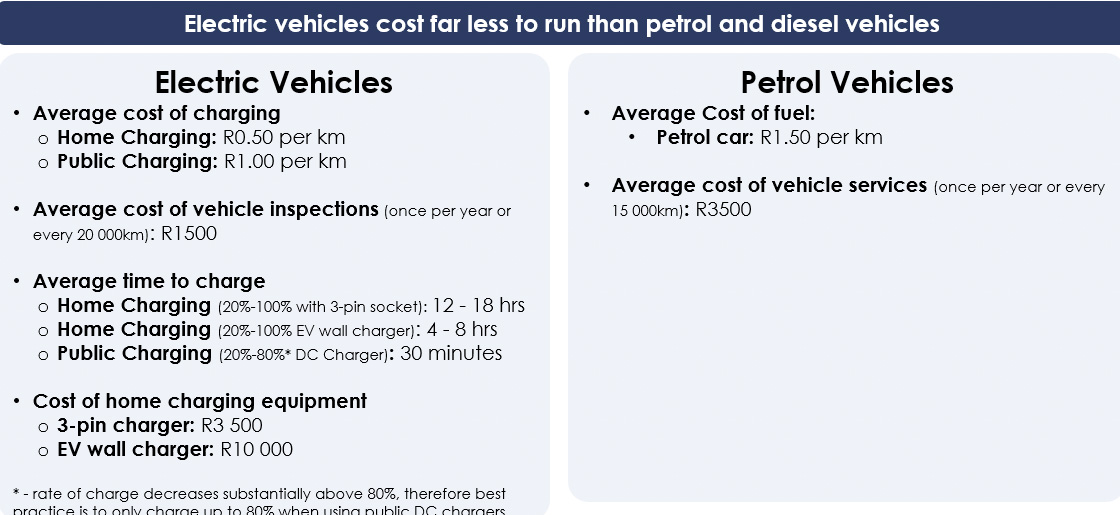
Charging slows significantly above 80%, making 80% a practical target when using public DC charging. Practically, this means, at home, charge while you sleep- on the road, charge while you take a break.
Do I need to install a charger at home?
Not necessarily. You can use a standard 3-pin charging option, or a dedicated EV wall charger.
- 3-pin charger Approximately R3 500
- EV wall charger Approximately R10 000
Your choice will depend on your vehicle, your driving needs and how quickly you want to charge at home.
What if i need to charge away from home?
Charging infrastructure is growing.
There are currently 458 public EV charging locations in South Africa
208 DC charging locations
250 AC charging locations
You can find live, interactive maps of public EV charging stations in the Western Cape on platforms AutoTrader Live EV Charging Map or the Drive South Africa EV Map.
Plan your journey, find charging locations along the way and make charging part of your travel routine.
What about servicing?
Your car still needs care, but the routine can be different.
For example:
- EV: R1 500 - Average vehicle inspection once a year or every 20 000 km.
- Petrol vehicle: R3 500 - Average service once a year or every 15 000 km.
This is another reason to look beyond the initial purchase price when comparing vehicles.
Find the EV that fits your life
There's no single EV that's right for everyone.
Think about:
- How far do you drive every day?
- Where will you charge?
- How much space do you need?
- What is your budget?
- Do you regularly travel long distances?
Once you know what you need from your vehicle, you can start comparing your options.
Ready to explore electric?
Your next car doesn't have to run on petrol.
EV ownership can mean a different way of fuelling, a different approach to maintenance and potentially lower everyday running costs.
Find out what could work for you.
- Explore EV models
- Find charging stations for your regular travel routes
- Compare running costs to a petrol vehicle
Information on this page is intended to provide general guidance. Vehicle prices, specifications, charging availability, electricity tariffs, fuel prices and operating costs can change. Always confirm current vehicle specifications, pricing and charging information with the relevant manufacturer, dealer or charging provider.