
Taking Western Cape infrastructure innovation to the global stage
Media Release by the Western Cape Minister of Infrastructure Tertuis Simmers
The Western Cape Government Department of Infrastructure (DOI) has taken its vision for integrated, technology-enabled infrastructure delivery to the global stage through its participation at the AI for Developing Countries Forum (AIFOD) Summit, held in Geneva, Switzerland, from 12 to 14 August 2026.
At the Summit, the Department showcased how the Western Cape is combining long-term infrastructure planning, trusted data, digital technology, and responsible artificial intelligence (AI) to improve the way infrastructure is planned, prioritised, funded, and delivered.
A key highlight of the Summit was the keynote address delivered by Ms Labeeqah Schuurman, Deputy Director-General for Strategy, Policy and Coordination in the Western Cape, Department of Infrastructure. Speaking under the theme "AI and Infrastructure Must Remain in Service of People", Schuurman emphasised that AI should be viewed not as an end in itself, but as a tool for building governments and institutions that work better for citizens.
Drawing on lessons and innovations emerging from the Western Cape, Schuurman noted that the challenge facing many developing economies is often not a lack of ambition, but rather fragmented systems, infrastructure backlogs, limited institutional capacity, and insufficient coordination between governments, businesses, and communities.
"Technology must support development outcomes. AI should strengthen our ability to govern, plan and deliver better services, while keeping people at the centre of decision-making", said Schuurman.
She highlighted that infrastructure extends far beyond physical assets such as roads, hospitals, dams, ports and airports. Infrastructure provides the foundation for economic growth, social inclusion, resilience and human dignity. It provides the foundation for economic opportunity, social inclusion, resilience and human dignity.
She outlined the Western Cape’s effort to connect infrastructure priorities, projects, governance, investment and implementation within a more coherent system, increasingly supported by digital technology and AI.
Addressing fragmentation through integration
During the IRB Digital Infrastructure Session, the Western Cape Department of Infrastructure presented its integrated model for transparent, AI-enabled infrastructure delivery.
Chaired by René Kok of the Western Cape Government, the session brought together co-chairs Labeeqah Schuurman and Valerie J. Pelton of Tracked Biotechnologies (USA), alongside Jodie Thomas of the Western Cape Government.
Central to the discussion was a challenge faced by governments worldwide, namely fragmentation. Infrastructure projects, data, governance systems, investment mechanisms and long-term planning often operate in isolation from one another. The Western Cape's model seeks to connect these elements within a single ecosystem, using technology and AI not as substitutes for government capability, but as tools to strengthen it.
The Department's approach is anchored in three Western Cape Government Cabinet-approved artefacts, namely:
- Western Cape Infrastructure Framework 2050 (WCIF 2050), which establishes the long-term vision;
- Western Cape Infrastructure Strategy 2050 (WCIS 2050), which identifies strategic sector priorities; and
- Western Cape Infrastructure Implementation Plan 2050 (WCIIP 2050), which creates an integrated pipeline of infrastructure projects across the short, medium and long term.
Together, these instruments provide a clear progression from vision to implementation and enable the Province to connect strategic priorities with project preparation, evaluation, prioritisation, financing and delivery.
Infrastructure-as-a-Service and the Digital Twin Vision
Supporting this integrated approach is the Western Cape's Infrastructure-as-a-Service Platform, the technological enabler of the WCIF 2050 vision. The platform is designed to improve both the Ease of Doing Government and the Ease of Doing Business by creating an intelligent digital environment where infrastructure opportunities can be identified, evaluated and advanced towards investment and delivery. Alongside this platform, the Department is driving the development of a digital twin of the Western Cape, bringing together infrastructure, technology and data into an increasingly comprehensive digital representation of the Province.
Over time, this capability will support smarter planning and decision-making, enabling infrastructure that is more sustainable, resilient, connected and efficiently delivered.
AI should strengthen human judgement
A consistent message from the Western Cape throughout the Summit was that AI should strengthen human judgement, not replace it. A key finding formally recorded during the Digital Infrastructure Session stated:
“Fragmentation, rather than a lack of ambition or technology, is one of the greatest barriers to effective infrastructure delivery. Connecting long-term strategy, governance, projects, data and implementation creates the foundation for better decisions and greater impact”. The finding shifts the conversation beyond technology adoption alone.
The Western Cape presented a different alternative:
“Instead of digitising fragmented systems, governments can adopt an integrated, AI-enabled infrastructure ecosystem that connects strategy to a single project pipeline, strengthens project preparation and prioritisation, and creates clearer pathways from community need to investment and delivery”.
Digitising fragmentation does not solve fragmentation. The objective is to first integrate the system and then use technology to strengthen the connections between its various parts.
Building Institutional Capability Before Technological Dependency
The session concluded with a shared commitment to building institutional capability before technological dependency.
The session's institutional commitment brought these principles together:
“We commit to building institutional capability before technological dependency by using data and AI to strengthen human judgement, governance and implementation, while developing solutions grounded in the realities and priorities of the Global South”.
This positions AI as an enabling layer within broader government capability rather than the capability itself.
For governments exploring their own AI and infrastructure strategies, the key lesson emerging from Geneva was clear: Do not simply digitise the system you already have. Build the institutional capability to integrate it.
Strategic collaboration with AIFOD
A significant milestone of the Summit was the formalisation of a collaborative relationship between the Western Cape Department of Infrastructure and the AI for Developing Countries Forum (AIFOD) through the signing of a Statement of Intent.
The agreement reflects a shared intention to explore strategic collaboration on the responsible use of AI, data and digital technologies in infrastructure planning, governance and delivery. The parties will identify priority areas for collaboration and develop a joint programme of work, including potential AI use cases linked to the WCIF 2050, WCIS 2050 and WCIIP 2050, as well as exploring the application of the (Future AI Investment Responsibility) FAIR Framework within infrastructure procurement and delivery.
The outcomes of this Statement of Intent will inform a future Memorandum of Cooperation outlining agreed areas of cooperation, governance arrangements, priority initiatives, and the respective roles and responsibilities of the parties.
Representing the Western Cape on the Global Stage
Labeeqah Schuurman also co-hosted with Tianze Zhang, the Founder of AIFOD the AIFOD FAIR Closing Dialogue, themed "From Trust to Implementation: How Can Governments, Enterprises and Communities Turn FAIR into Real-World Action?" The discussion highlighted the Western Cape's work in developing a scientifically grounded, people-centred and empathetic platform for public governance, demonstrating how a sub-national government is already applying AI within governance structures to support evidence-based decision-making and improve service delivery.
In the spirit of the Western Cape Government's principle that "Small Takes the Lead," the Department's participation at AIFOD demonstrated how responsible AI, trusted data and digital technologies can strengthen institutional capability, improve infrastructure delivery and contribute to resilient, inclusive and sustainable development across the Global South.
Recognised as small nation AI leadership
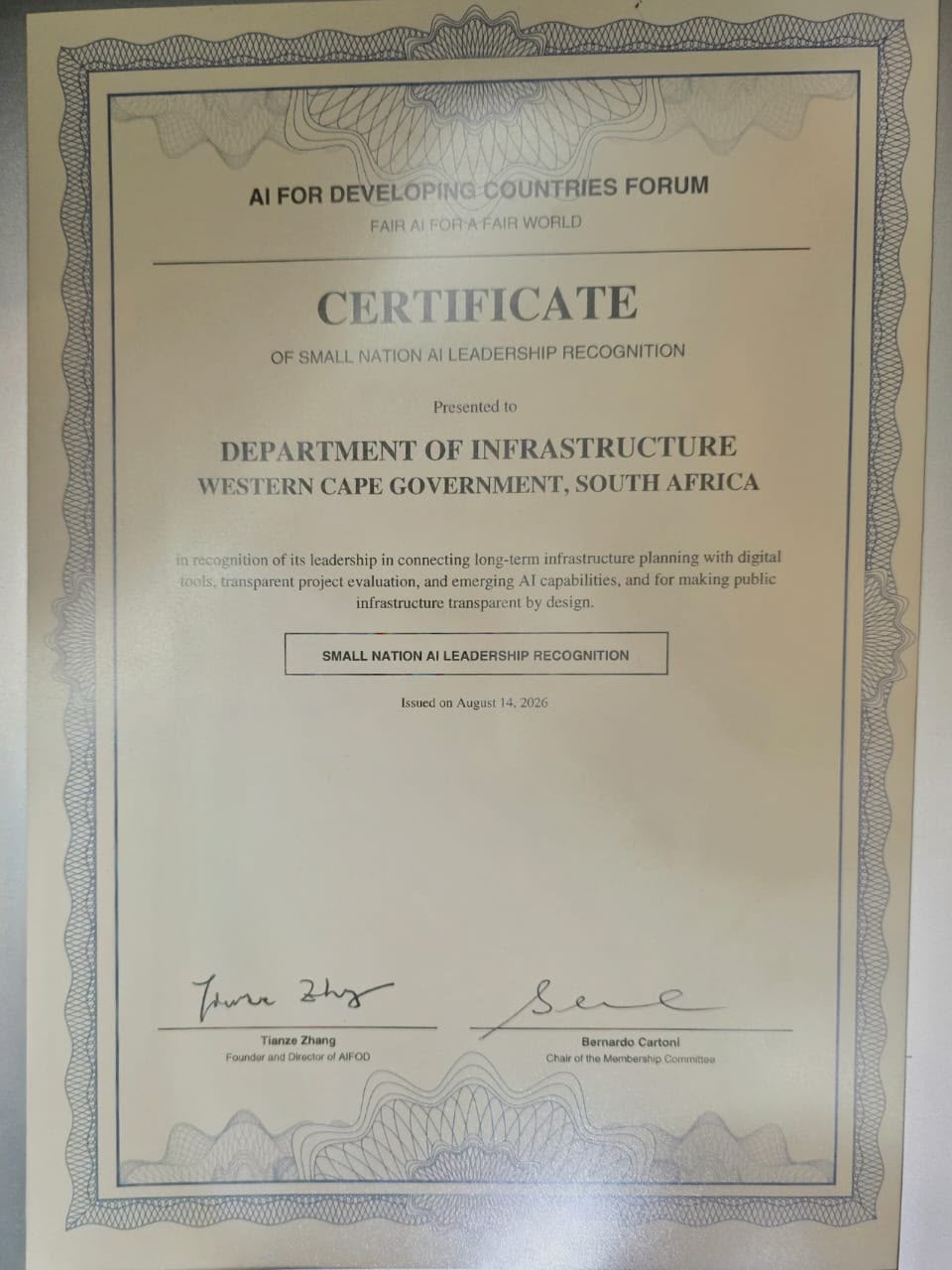
The Western Cape Government, Department of Infrastructure was invited to be nominated for the inaugural Small Takes the Lead Global Recognition for the category Small Nation AI Leadership.at the Palais des Nations in Geneva. The category recognises national AI strategy, digital sovereignty, AI in public services, and the leadership of smaller states in international AI governance.
The Western Cape's Infrastructure-as-a-ServicePlatform was nominated as a Sub-national public administration delivering digital public services at scale, the level of government at which AI adoption meets citizens most directly.
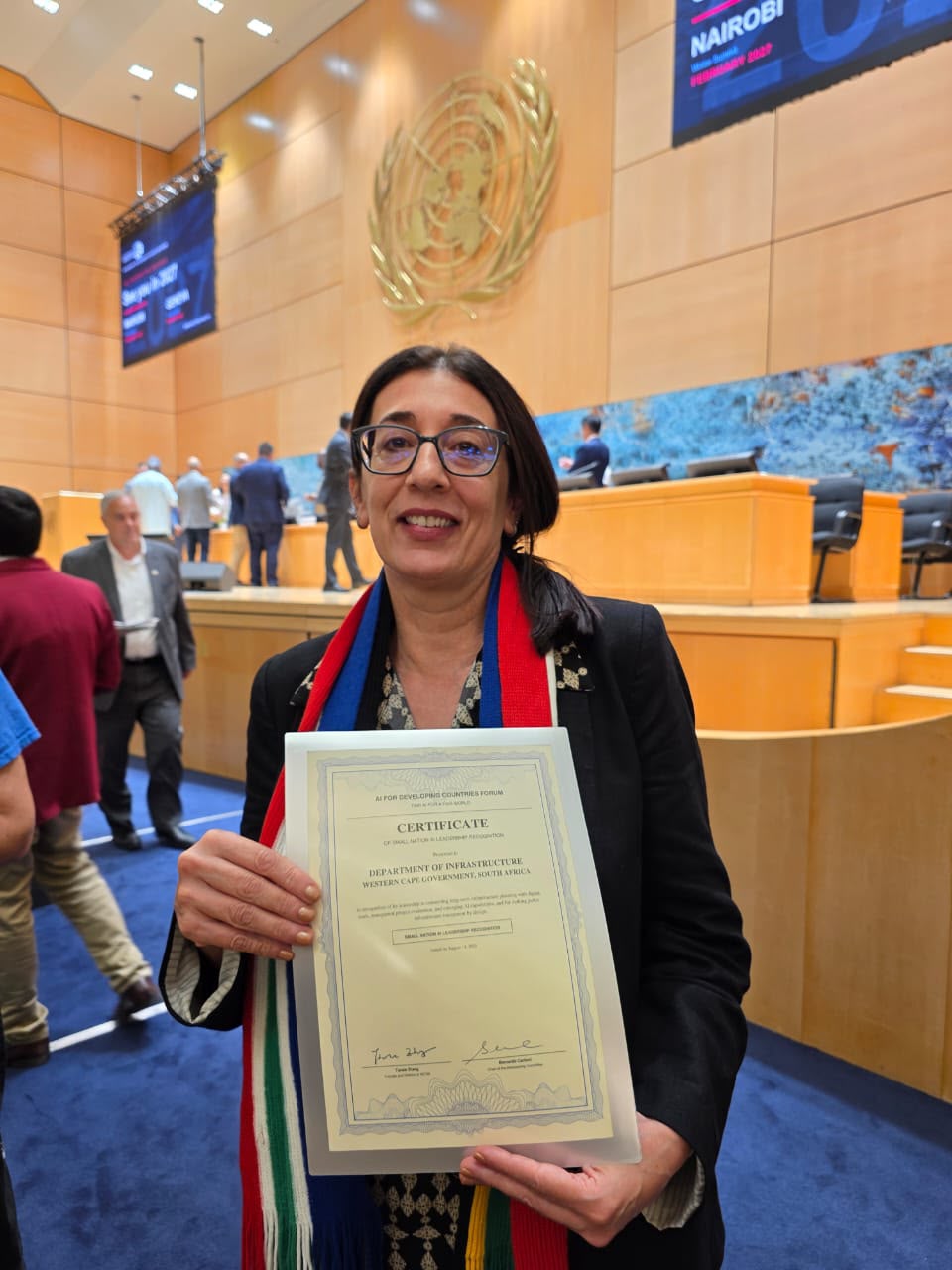
At the AIFOD Summit in Geneva on 14 August 2026, Ms Labeeqah Schuurman received the award on behalf of the Department of Infrastructure, Western Cape Government. This award is in recognition of its leadership in connecting long-term infrastructure planning with digital tools, transparent project evaluation, and emerging AI capability, and for making public infrastructure transparent by design.
At the Inaugural Western Cape Infrastructure Ministerial Roundtable held on 30 July 2026, Minister Tertuis Simmers launched the Western Cape's Infrastructure-as-a-Service Platform. “I am proud that the Western Cape Infrastructure Innovation has been showcased on this global stage.” Said Mr Tertuis Simmers, Western Cape Minister of Infrastructure.
Watch: Minister Simmers and HOD Smith AIFOD messages
Audio
Media Enquiries:
Melt Botes
Spokesperson to Provincial Minister Tertuis Simmers
Email: Melchior.Botes@westerncape.gov.za
Tel: 021 483 8067
Cell: 082 431 0068
Stephen Heyns
Acting Head of Communications
Western Cape Department of Infrastructure
Email: Stephen.Heyns@westerncape.gov.za
Tel: 021 483 0597